

Today, the demands of consumers are increasing in the direction of using natural preservatives instead of chemical preservatives in wines. With the understanding of the side effects of many chemical preservatives, studies are continuing to research and develop different methodologies to protect the wines.
Many chemical preservatives are authorized as antimicrobials during winemaking such as sorbic acid, ascorbic acid, dimethyl dicarbonate (DMDC), lysozyme. Dimethyl dicarbonate (DMDC) inhibits microorganisms with a maximum authorized dose of 200 mg/L without any detectable residue in the final product. 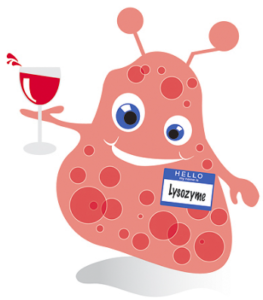 The use of lysozyme is also possible, it is an input made from egg white. It has an antibacterial action and can be used at the end of malolactic fermentation to stabilize wines. It is very effective against “piqure lactique” and cannot exceed 500 mg/L (Gerbaux et al., 1997). Sorbic acid acts as an anti-fungal and is very effective in preventing fermentation in the bottle. The maximum quantity allowed is 200 mg/L (Divol et al., 2005). Among them, although lysozyme is known to be effective on many microorganisms in wine, the high cost of obtaining this substance (enzyme use, clarification process) is the reason why it is not preferred by wine producers (Azzolini et al., 2010).
Among other alternative protective bacteriocins, nisin is the only bacteriocin allowed to be used in foods (Buzrul, 2012). It has been reported that bacteriocins have an inhibitory effect on bacteria, but not on yeasts (Rojo-Bezares et al., 2007). In addition to these methods, non-thermal techniques such as hydrostatic pressure, pulsed electric field (PEF), ultrasonic and ultraviolet have been tested as an alternative to SO₂ in wine production (Briones- Labarca et al., 2017).
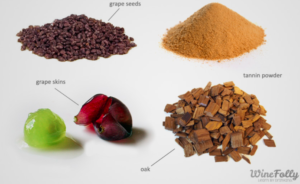
Red wine is particularly rich in tannins and therefore less tend to oxidation than white or rosé wines. Tannins can be obtained from grape seeds, as well as from tannin-rich oak trees or from commercially produced gallic acid and ellagic acid. It is a glucoside compound consisting of a mixture of gallotannins, ellagitannins, and proanthocyanidins (Jourdes, 2019). Pascual et al., (2017) stated that the antioxidant capacity of ellagitannins can be a good alternative to SO₂ in their study to compare the oxygen consumption capacities of enological tannins obtained from different sources in model wines with SO₂. In addition, proanthocyanidins are good antimicrobials in that they damage the cell wall of microorganisms and inactivate metabolism by binding to enzymes (Makarewicz et al., 2021). During the winemaking process, it is possible to enrich and preserve wines with tannins derived from grapes or oak. According to Alamo-Sanza et al. (2019) studies, oak chips and tree extract are effective against the development of acetic acid bacteria, that cause wine deterioration, as well as its antioxidant activity. The use of these substances (such as enological tannins or wood chip extracts), which have the potential to be an alternative to SO₂, is allowed in international wine legislation, and the effects of these alternatives on wines are currently being tested (OIV).
Herbal extracts are natural substances that can be an alternative to SO₂, as they have high antioxidant and antimicrobial activity, as well as being inexpensive. Similar to the approach for oak chips, vine shoots are also an oenological material with high potential. Vine shoot extract has high antioxidant and antimicrobial properties thanks to its volatile and phenolic components, as well as contributing to the color and taste characteristics of wine. This new alternative was studied with stilbenes-rich vine shoot extract. Raposo et al. (2018), in their study in wines with added vine shoot extract containing 29% (w/v) stilbene, the results showed higher scores on color-related parameters and sensory scores compared to the control group wines added with SO₂.
 Olive oil waste is a rich source of phenolic compounds, as is wine production waste. 50% (w/w) of phenolic compounds found in olives and extra virgin olive oil are hydroxytyrosol and its derivatives, which is a low-cost bioactive compound with high antioxidant activity and good antimicrobial properties (Raposo et al., 2016). In Syrah wines, hydroxytyrosol obtained from olive waste has been proposed as an alternative to SO₂. Raposo et al. (2016) examined white wines treated with hydroxytyrosol and SO₂ at the wine production stage. Hydroxytyrosol has been observed to improve color as well as odor and flavor in the bottle. However, after 6 months of storage in the bottle, wines treated with hydroxytyrosol were found to be more subject to oxidation than SO₂ wines.
Chitosan has attracted more attention in recent years because of its antimicrobial activity against a wide range of microorganisms, including bacteria, yeast, and moulds (Aider 2010). Contrary to SO₂, chitosan has been observed to affect more quickly on fungi than on bacteria (Goy et al., 2009). In terms of human health, it’s important to note that chitosan is generally recognized as safe by the US Food and Drug Administration (FDA) (Giatrakou et al., 2010). Since chitin, the major element of chitosan, is the second most prevalent polysaccharide found in nature after cellulose and is a waste product of aquaculture, it is also economically advantageous over other natural preservatives like lysozyme, nisin, and killer toxins (Aider 2010). Picariello et al. (2020) studied the use of chitosan in order to reduce the amount of SO₂ bound to acetaldehyde, it was observed that there was a lower SO₂ bound to acetaldehyde production in the finished wine after the use of chitosan right after the fermentation.
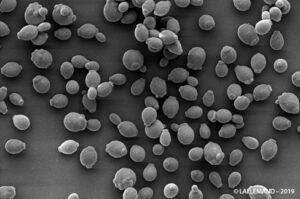 A biological alternative to the use of sulfites is bio protection. The simplest definition of bio protection is the early and massive contribution of preselected microorganisms to the harvest or must. The added bio-protectress must become predominate over all indigenous microorganisms. These are yeast strains that ferment poorly and do not produce volatile acidity. Sulfite addition reduces the initial indigenous microbial population and its biodiversity but does not prevent persistence in the must of Brettanomyces strains that are more resistant to SO₂. The addition of bio-protectress also limits the indigenous biodiversity of the must but, unlike a sulphated must, its predominance would have no selective effect on the microorganisms initially present (Simonin et al., 2019). Windholtz et al., 2021, show in their study that the use of non-Saccharomyces yeast, notably Torulaspora delbrueckii, as bio protection has been shown to have a good potential for dominating the must and limiting wine defects. In addition, it is seen that the aromatic profile of the wine with the use of non-Saccharomyces is perceived as fruitier and fresher.
Another possible alternative to SO₂ is glutathione. Each wine compound is characterized by a redox potential, which allows them to be classified according to their ease of being oxidized: the lower the redox potential, the more easily the compound is oxidizable. Glutathione has a low redox potential (very strong reducing power), so it will be oxidized as a priority, thus protecting the other compounds. Glutathione is a natural compound which is rejected by the yeasts at the end of alcoholic fermentation. Other compounds have a similar action (SO₂, Vitamin C,…) but not as strong as glutathione (Teissedre, 2019).
Finally, among the alternatives to SO₂, there is also the use of inert gases (N2, CO2, Ar, …). In this way, the must and wine are protected from acetic acid bacteria and oxidation.
References:
Aider, Mohammed. “Chitosan Application for Active Bio-Based Films Production and Potential in the Food Industry: Review.” LWT – Food Science and Technology, vol. 43, no. 6, July 2010, pp. 837–42. https://doi.org/10.1016/j.lwt.2010.01.021.
Alamo-Sanza, Maria del, et al. “Impact of Long Bottle Aging (10 Years) on Volatile Composition of Red Wines Micro-Oxygenated with Oak Alternatives.” Lebensmittel-Wissenschaft, Elsevier Ltd, 2019.
Azzolini, Michela, et al. “Evaluating the Efficacy of Lysozyme Against Lactic Acid Bacteria Under Different Winemaking Scenarios.” J. Enol. Vitic, vol. 31, Jan. 2010. https://doi.org/ 10.21548/31-2-1406.
Briones-Labarca, Vilbett, et al. “Oenological and Quality Characteristic on Young White Wines (Sauvignon Blanc): Effects of High Hydrostatic Pressure Processing.” Journal of Food Quality, vol. 2017, no. 8524073, 2017. Pontifical Catholic University of Valparaíso – PUCV, https://doi.org/10.1155/2017/8524073.
Buzrul, Sencer. “High Hydrostatic Pressure Treatment of Beer and Wine: A Review.” Innovative Food Science & Emerging Technologies – INNOV FOOD SCI EMERG TECHNOL, vol. 13, Jan. 2012, pp. 1–12. https://doi.org/10.1016/j.ifset.2011.10.001.
Divol, Benoit, et al. “Effectiveness of Dimethyldicarbonate to Stop Alcoholic Fermentation in Wine.” Food Microbiology, vol. 22, no. 2, Apr. 2005, pp. 169–78. https://doi.org/10.1016/ j.fm.2004.07.003.
Gerbaux, V., et al. “Use of Lysozyme to Inhibit Malolactic Fermentation and to Stabilize Wine After Malolactic Fermentation.” American Journal of Enology and Viticulture, vol. 48, no. 1, American Journal of Enology and Viticulture, Jan. 1997, pp. 49–54.
Giatrakou, V., et al. “Combined Chitosan-Thyme Treatments with Modified Atmosphere Packaging on a Greek Ready-to-Cook (RTC) Poultry Product.” Journal of Food Protection, vol. 73, Apr. 2010, pp. 663–69. https://doi.org/10.4315/0362-028X-73.4.663.
Goy, Rejane, et al. “A Review of the Antimicrobial Activity of Chitosan.” Polimeros-Ciencia E Tecnologia – POLIMEROS, vol. 19, Jan. 2009. https://doi.org/10.1590/ S0104-14282009000300013.
Jourdes, Michael. Master Sciences de la Vigne et du Vin 1ère année, UE 10 Conservation et évolution du vin, 2019.
Makarewicz, Małgorzata, et al. “The Interactions between Polyphenols and Microorganisms, Especially Gut Microbiota.” Antioxidants, vol. 10, no. 2, Jan. 2021, p. 188. https://doi.org/10.3390/antiox10020188.
Pascual, Olga, et al. “Oxygen Consumption Rates by Different Oenological Tannins in a Model Wine Solution.” Food Chemistry, vol. 234, Nov. 2017, pp. 26–32. https://doi.org/10.1016/j.foodchem.2017.04.148.
Picariello, Luigi, et al. “Effectiveness of Chitosan as an Alternative to Sulfites in Red Wine Production.” European Food Research and Technology, vol. 246, no. 9, Sept. 2020, pp.1795–804. https://doi.org/10.1007/s00217-020-03533-9.
Raposo, R., et al. “Effect of Hydroxytyrosol on Quality of Sulfur Dioxide-Free Red Wine.” Food Chemistry, vol. 192, Feb. 2016, pp. 25–33. https://doi.org/10.1016/j.foodchem.2015.06.085.
Raposo, Rafaela, et al. “Sulfur Free Red Wines through the Use of Grapevine Shoots: Impact on the Wine Quality.” Food Chemistry, vol. 243, Mar. 2018, pp. 453–60. https://doi.org/10.1016/j.foodchem.2017.09.111.
Simonin, Scott, et al. “La Bioprotection. Une Alternative Biologique Partielle Ou Totale à l’addition de Sulfites.” Revue Des Oenologues, 2019.
Teissedre, Pierre-Louis. “Dioxyde de Soufre, Effets et Alternatives.Perspective de La Recherche En Oenologie.” Revue Des Oenologues, 2019.
Windholtz, Sara, et al. “Non-Saccharomyces Yeasts as Bioprotection in the Composition of Red Wine and in the Reduction of Sulfur Dioxide.” LWT, vol. 149, May 2021. https://doi.org/ 10.1016/j.lwt.2021.111781.