Phenolic ripeness is when the grape reaches its optimum concentrations of phenolic compounds (anthocyanins and tannins). There are big sources of variability in berry ripeness.
It depends on the grape varieties, which have different characteristics. There is also variation depending on geographical origin. At the soil level, there is the dissolution of mineral components found in different soils and different water availability, depending on whether it is limestone, gravel, or clay. Certain components must be present for reactions to take place (for example, an enzyme that needs copper or certain mineral elements to function). Organic matter in the soil is also important.
The climate also has an effect, there are different inferences depending on whether the region is dry with little rain or a lot of rain. Depending on the amount of water in the soil, there may be ripening blockages. Cultural practices are also to be taken into account, they influence the ripening of the grapes. You have to think about whether you add mineral or organic fertilizers.
The level of maturity is also to be taken into consideration. The juice or the pulp brings sugars and acids, we pay attention more to the sugars/acids ratio. The seed brings color (presence of phenols, in particular, tannins) through the tannins. In the pulp, there are phenolic compounds (with tannins and anthocyanins, which also provide color) and aroma precursors with aroma compounds which are qualitatively and quantitatively important. In the grape skin, there are also parietal polysaccharides, these are sugar/monosaccharide chains that have important taste properties.
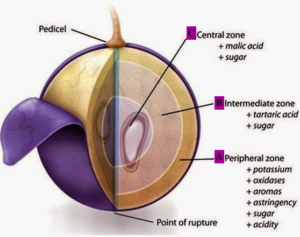
There are 3 zones in the grape berry. Zone A is the peripheral zone of the pulp, it includes the skin and a small part before the pulp. This is the area least rich in organic acids (3 g of H₂SO₄/L) but there is a good concentration of sugar (180 g/L). Zone B is the intermediate zone, between the seeds and the skin, it is very rich in sugars (190 g/L) and has 2 times more acidity than zone A (5.7 g of H₂SO₄/L). Zone C is the central zone, close to the seeds, it is the poorest in sugars (166 g/L) but the richest in acids (8.8 g of H₂SO₄/L).